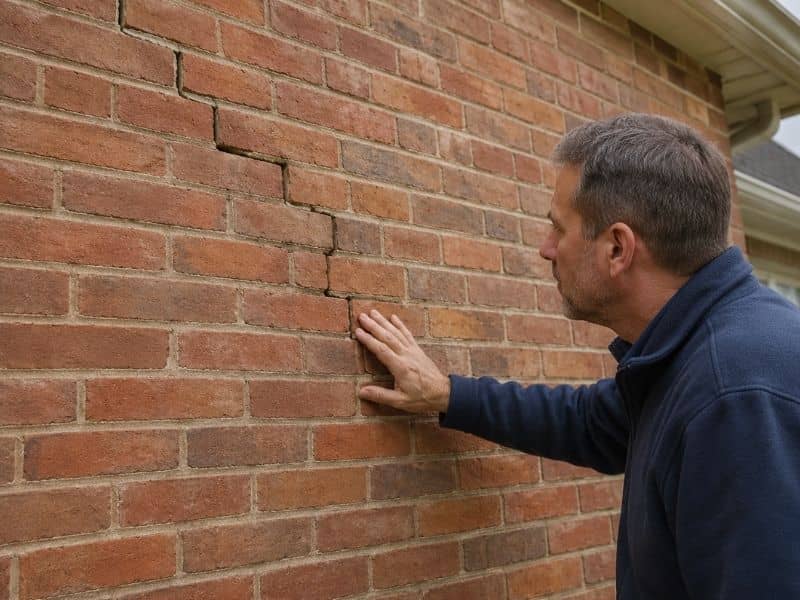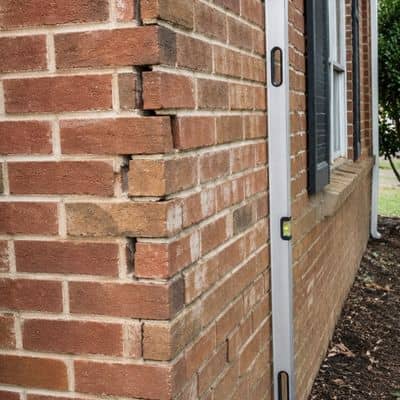
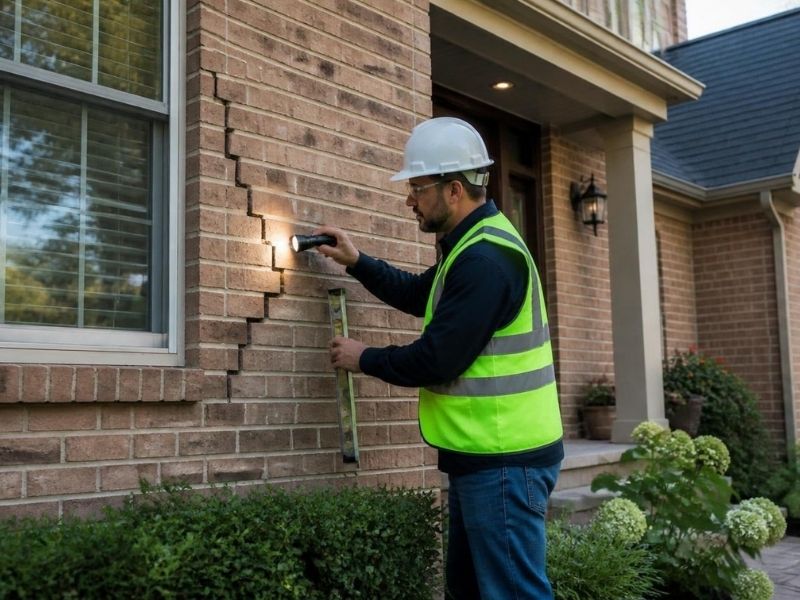
Every crack in your brick shows up somewhere specific. Almost never in the middle of a blank wall. Almost always at a corner of a window or a door.
That’s not coincidence, and it’s the first thing a good brick repair starts with. While some situations eventually require brick replacement, the real priority is identifying why the wall moved in the first place. Openings are where a wall is weakest, so they’re where movement announces itself first. The crack didn’t pick that spot at random.
Here’s the takeaway. The stair-step crack at your window corner is a symptom with a cause, and repairing the brick without finding that cause means paying for the same crack twice.
Windows and Doors Are the Weakest Interruptions in a Brick Wall
A brick wall works as one continuous unit. Load spreads sideways through the courses and down to the foundation, so a solid wall shares stress across a wide path. That sharing is what makes masonry strong.
Cut a hole in it and that path breaks. Load has to travel around the opening instead of through it, which concentrates stress at the four corners. Those corners are now carrying more than their share.
Openings also change how the wall moves. Brick expands and contracts with temperature and moisture, and a solid wall does that evenly. A wall full of windows moves unevenly, since the sections between openings are narrow and the sections above are supported by something other than brick.
So when anything shifts below or behind the wall, the corners go first. They’re the concentration points, and cracking is how they release.
Stair-Step Cracks Follow the Mortar Because It’s Designed to Give First
Mortar is the weaker material by design, so a crack takes the easiest path through the wall. That path runs along the joints rather than through the brick.
The staircase shape is just geometry. A crack moving diagonally has to alternate between horizontal bed joints and vertical head joints, since those are the only continuous weak lines available. It steps because the brick pattern forces it to.
That shape tells you something useful. Stair-step cracking means one part of the wall moved relative to another part, and the crack is tracing the boundary between them. If a crack runs straight through the brick faces instead of around them, the force involved was strong enough to beat the brick, and that changes the conversation.
The Direction of the Crack Often Points Toward the Cause
Start with where the crack begins and which way it travels. Successful brick crack repair starts by understanding that pattern, since the direction of the crack often reveals what caused the movement in the first place. Cracks tend to open widest at the end furthest from whatever is holding still, so the wide end points away from the stable ground.
A stair-step crack running down and outward from a lower window corner usually says settlement. Something under that part of the wall dropped, and the wall above followed, tearing at the weakest corner. The width at the bottom tells you roughly how far.
A crack running upward and outward from an upper corner often says the opposite. That section lifted or the section beside it dropped. Either way, differential movement between two parts of the same wall.
Watch for cracks paired with displacement at the top of an opening. Steel lintels above windows and doors rust, and rusting steel swells with real force. Cracks radiating from both upper corners, especially with the brick above pushed outward, points at the lintel rather than the ground.
Thermal movement has its own signature. It shows as thin cracks that open in winter and close in summer, usually at the same locations year after year. That crack is annoying rather than dangerous, and treating it like settlement wastes money.
Not Every Stair-Step Crack Needs the Same Repair
The crack doesn’t decide the repair. The cause does.
Repointing works when the movement has stopped and the brick is sound. A mason rakes out the cracked joints and packs in compatible mortar, which restores the joint without touching brick. That’s the cheapest outcome and it’s real when the conditions are right.
Brick replacement enters when individual bricks cracked through or spalled. Sound brick around a failed one gets left alone, since every brick removed disturbs its neighbors. Good masons take out as few as the job allows.
Lintel repair is a different job entirely. Fixing rusted steel means supporting the brick above, removing or treating the lintel and rebuilding. Repointing a lintel crack accomplishes nothing, because the steel keeps swelling underneath your new mortar.
Structural stabilization comes when the ground is the problem. Foundation work happens first, and masonry follows. A mason who offers to fix settlement cracking with mortar is selling you a delay.
Lasting Repairs Focus on Movement Before Masonry
The question that decides everything is whether the wall is still moving. Everything else follows from the answer.
Masons check it a few ways. Crack width gets measured and marked so it can be re-read later, and monitoring over a season separates active movement from an old scar. Fresh, clean crack faces suggest recent movement. Dirty, weathered faces suggest something that happened years ago and stopped.
Active movement means repair waits. Pack mortar into a crack that’s still opening and it fails in the same line, usually within a year or two. That repair looked perfect for one winter and cost you the price of doing it twice.
Sequence is the whole thing. Find the cause, stop it, then rebuild. Any other order is cosmetics with an invoice attached.
Frequently Asked Questions
Why do stair-step cracks usually form around windows and doors?
Windows and doors interrupt the wall’s continuous load path, concentrating stress at their corners. When the structure shifts, these areas are often the first places where stair-step cracks appear.
Why do stair-step cracks follow the mortar joints instead of the bricks?
Mortar is intentionally softer than brick, so it becomes the path of least resistance when movement occurs. Cracks that pass directly through the brick itself often indicate greater structural stress.
Can stair-step cracks be repaired by repointing the mortar alone?
Only if the underlying movement has stopped. Repointing a wall that is still shifting usually results in the same crack returning because the root cause remains unresolved.
How can I tell if a failing lintel is causing the crack?
Cracks that begin at the upper corners of a window or door, combined with displaced bricks or widening mortar joints above the opening, can indicate a deteriorating steel lintel that needs further inspection.
Should I repair a stair-step crack right away or monitor it first?
It depends on whether the crack is still active. A professional may recommend monitoring the crack over time to determine if movement has stopped before performing permanent masonry repairs.